Latin for Gardeners

Latin for Gardeners: November 2020

November’s Native Maryland Plant
Quercus phellos
(KWURK-us FELL-us) L.
Common Name: Willow Oak

Quercus_phellos_Main.jpg

As master gardeners, naturalists and watershed stewards we are often asked to recommend trees suitable for a yard, community planting or restoration project.  When this happens, we often turn to our Native Plants for Wildlife Habitat and Conservation Landscaping manual for guidance.  The list of native trees is diverse, but the number of native Quercus species listed is twice that of the second most populace species, Pinus.  It should come as no surprise then, that in the mid-Atlantic states much of our forest is defined by the Quercus (Oak) genus.

In fact, Quercus species are highly valued for the vast ecosystem services they provide and are considered ‘keystone’ species for the inherent value they bring to an environment.  Across the nation ‘Oaks are ranked either number one or number two in their support of the food web in 84% of all U.S. counties in which they occur.¹

Quercus_phellos_meaning.jpg

I frequently recommend Oaks on projects because of their ecological value and because there is an oak to fit most any site condition. Quercus phellos is commonly planted as an ornamental tree; planted in a ‘good’ site it has moderate to rapid growth, it’s able to withstand sun and part-shade, is salt and wind-tolerant (once established) and has easily compostable willow-like leaves. Like all oaks, Quercus phellos is an excellent shade tree that casts a long shadow that can shade a home or paved area; it is a suitable street tree if there are no overhead wires.

When using trees in a landscape it is always important to discuss maintenance.  A tree needs its requisite sun, water, and room to grow, but it also needs to be protected from invasive species that may climb its trunk and smother its branches.   To thrive, routine maintenance should include identifying and removing invasive species from around its trunk and beneath its branches. 

Quercus_phellos_Ivy.jpg

If you want to increase biodiversity, help protect your watershed, and improve air quality, look for places where you can plant this keystone species - you should not have to go far. 

¹ Nature’s Best Hope, Doug Tallamy (Narango, Tallamy and Shropshire 2018)

~ Alison Milligan – Mstr. Gardener/Mstr. Naturalist/Mstr. Watershed Steward

Chesapeake Bay Landscape Professional (CBLP)

aligmilligan@gmail.com

Latin for Gardeners: October 2020

October’s Native Maryland Plant
Mimulus ringens L.
(MIM-yoo-luss RIN-jens)
Common Name: Monkey Flower

Mimulus_ringens_Main.jpg

Temperatures have dropped significantly since Mimulus ringens was in full bloom, yet a few hardy flowers still cling to its branches, inviting any late season pollinators that happen to be passing by.  This plant has been very productive in my yard, filling a persistently wet area while providing nourishment to many pollinators since late May.

In need of wetland plants, I selected monkey flower after reading that it was a host plant for the Common Buckeye butterfly – one of my favorites.  I also read that ‘older, post-hibernation larvae’¹ of the Baltimore Checkerspot will feed on it if it is planted near their primary host plant, Turtlehead (Chelone glabra). The Checkerspot has proven elusive in my garden despite the many Turtlehead plants I grow, but I remain hopeful that having Mimulus ringens sited nearby will further entice the state butterfly to consider my yard a worthy nursery.

Mimulus_ringens_Misc.jpg

Mimulus ringens is native to the wetlands of central and eastern North America.  Its stems emerge as early as February and by late May they’re surprisingly stiff, over 3’ tall and full of lavender blooms. This is a rhizomatic plant and its blooms grow opposite each other as a single pair on a long stalk that emerges from the leaf axil; they typically bloom on different days.  Its lance-shaped, serrated leaves are rotated 90 degrees from adjacent pairs.

Mimulus_ringens_Buckeye.jpg

I may never see a Baltimore Checkerspot butterfly in my garden, but I’ll continue to enjoy the Common Buckeye and take pleasure knowing that I’ve added a new host plant to support this local Lepidoptera.

¹ https://www.butterfliesofmassachusetts.net/baltimore-checkerspot.htm

² The angle between the upper side of the stem and a leaf, branch, or petiole.

~ Alison Milligan – Mstr. Gardener/Mstr. Naturalist/Mstr. Watershed Steward

Chesapeake Bay Landscape Professional (CBLP)

aligmilligan@gmail.com

Latin for Gardeners: September

How Are You Holding Up?

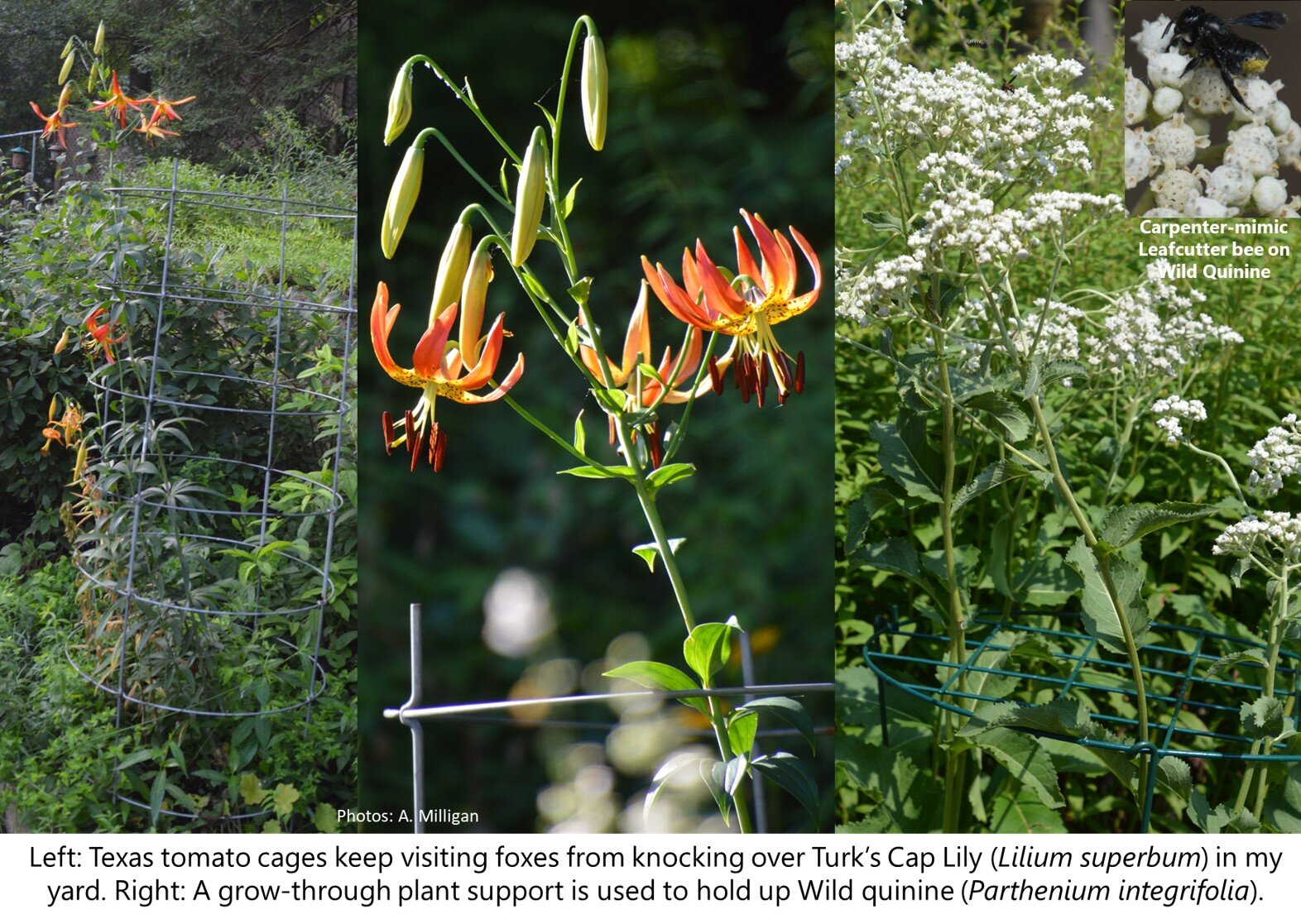
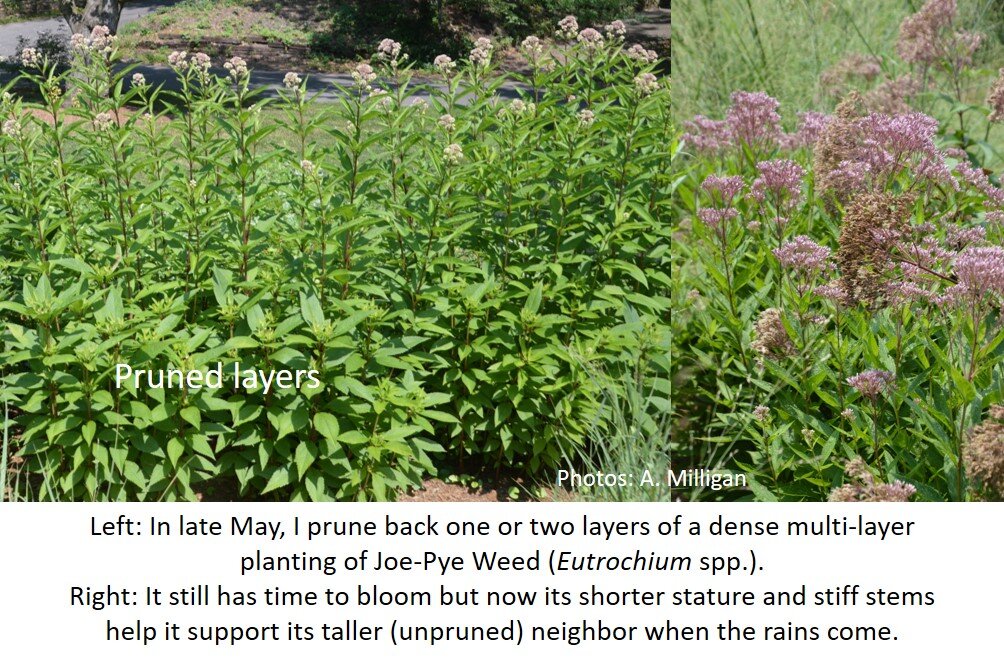
When people visit my home, I often hear them say, “You have so many tall plants! How do you keep them from falling over?”  As a native plant enthusiast, I don’t limit myself to just short plants – instead, I strive for biodiversity and finding the right plant to fit a site;  frequently that means planting one of the excellent, very tall perennials that Maryland is known for.  Over the years I have had to get creative to find ways to keep my plants standing tall while withstanding increasingly extreme weather. September is the wettest month of the year in Maryland and as we move further into hurricane season, I need to anticipate storms that can wreak havoc on a garden. 

Like many of you, I do most of the cleanup of my garden in early spring – rather than cutting plants back after blooming, I keep the seed heads of most plants available for birds and to provide overwintering areas for insects and the like.  Below are a few of the techniques I use to hold up plants in my garden:

Pollinator_Garden.jpg
Combo.jpg
TurksCap_Quinine.jpg
JPW_HoldingUp.jpg

Providing support for tall plants in your yard is important but in this time of coronavirus the more important question is, “How are you holding up?”  I miss spending time with my gardening and Watershed Steward friends. I can only hope you are all staying safe and that we will soon be able to get together again. Hopefully, like my Joe-Pye Weed, you are staying strong and providing your own support to a friend or neighbor. In the meantime, I will imagine you all doing a bit of native plant gardening.

~ Alison Milligan – Mstr. Gardener/Mstr. Naturalist/Mstr. Watershed Steward

Chesapeake Bay Landscape Professional (CBLP)

aligmilligan@gmail.com

Latin for Gardeners: July and August 2020

July and August Native Maryland Plants

Hypericum densiflorum Pursh.
(hy-PER-ee-kum den-see-FLOR-um)
Common Name: Dense St. John’s Wort

Hypericum prolificum L.
(hy-PER-ee-kum pro-LIF-ih-kum)
Common Name: Shrubby St. John’s Wort

Hypericum_Main.jpg

This month I want to share with you two plants that are commonly confused with one another: Hypericum densiflorum and Hypericum prolificum.  By discussing them side-by side I hope to show you how to differentiate them if you ever see them in your work or travels. These Hypericum spp. bloom all summer long, are native to the Mid-Atlantic states and are very low maintenance. Four years ago I planted a single specimen of each so I could learn to differentiate them; I sited them near each other along my driveway where they get full unobstructed sun and no maintenance.  They have been blooming profusely since early June and because of their proximity to one another are easily distinguished. 

Hypericum_Shrub_SideBySide.jpg

At first glance you notice that both the flowers and the leaves of H. densiflorum are noticeably smaller than those of H. prolificum and there are more flowers to each inflorescence.  True to its name, the habit and flowering of H. densiflorum is a much denser shrub with flowers that are tightly clustered. H. prolificum has a more open habit with slightly larger flowers that grow in less crowded clusters on a stem. The stems of each plant are worth a closer look:  H. densiflorum is smooth and copper colored while mature H. prolificum appears woody and exfoliates in winter, exposing a light brown to orange bark.

Hypericum_stems.jpg

Each plants’ flower has five petals and countless long yellow stamen that give the flower a frilly look -they can even obscure the petals. These flowers contain pollen but no nectar so bees are common visitors, butterflies are rare.  Interestingly, both shrubs are a host plant for the gray hairstreak butterfly (Strymon melinus) and several moths.  These Hypericum species leaf out early and are teeming with bees as soon as they get a single bloom.  They are often planted as erosion control plants; they have good drought tolerance and can easily be pruned to contain their height, if desired.

Hypericum_Genus_Species_bees.jpg

NOTE: Foliage contains a phototoxic chemical which deters deer and other herbivores.  Rutgers rates this plant a B: Seldom Severely Damaged by deer: https://njaes.rutgers.edu/deer-resistant-plants/

~ Alison Milligan – Mstr. Gardener/Mstr. Naturalist/Mstr. Watershed Steward

Chesapeake Bay Landscape Professional (CBLP)

aligmilligan@gmail.com