A Stormwater Success!

Early this fall, Stormwater Success, a short course for Property Managers and HOA Leaders,  went digital for about 30 County residents.

stromwater success 2.png

The first component was  Virtual Stormwater Success, developed by WSA's Restoration Coordinator, Josh Clark, in collaboration with our partners in Anne Arundel County Government and  the professional sector. This course provided property managers and HOA leaders with tools to reduce pollution coming from their properties and address their critical concerns, such as flooding, maintaining stormwater management devices, reducing management costs, and engaging their residents to reduce pollution from pet waste, litter, and other resources. 

You can find a taste of those resources here. If you would like more information, please contact Josh at jyetterclark@aacps.org

As part of Virtual Stormwater Success, participants attended an “Ask the Experts” session to connect them with stormwater professionals and County officials. Through these sessions, participants were able to troubleshoot community issues and brainstorm solutions. Knowledge in hand, they went back to their communities to promote best practices for managing pollution.

After gaining a base knowledge of stormwater practices, attendees were invited to join an in person Stormwater Best Management Practices Tour. With strict social distancing and safety protocols in place, tour participants visited local stormwater best management practices ranging from small scale infiltration practices to large scale stormwater ponds. 

By including a variety of practices and properties “in action”, attendees were able to draw connections between their own communities and potential pollution solutions. 

New to the Stormwater Success family this fall was an advanced seminar for HOA leaders, Stormwater Success: 201. The brainchild of Class 12 Steward Candidate Steve Miller, Stormwater Success 201 served as Steve’s capstone project for the WSA certification course. 

stromwater success.png

A dedicated group of about 15 County residents participated in this three-hour seminar, geared toward HOA/Condominium Association Board members and Property Managers. It provided education and resources to attendees who have - or will have - responsibilities for maintaining private stormwater management systems that were built in their communities using Environmental Site Design (ESD) criteria. This included practices such as rain gardens, dry wells, wet/dry swales, bioswales, bioretention areas, and stormwater ponds. 

Participants received information on stormwater system design, maintenance schedules for the most common Best Management Practices (BMPs), how to conduct inspections during and after storm events, as well as other actions to ensure successful near- and long-term operation of the stormwater management system.

The seminar also helped HOAs estimate annual and long-term costs for maintaining systems, learn how to hire the right service providers, and request credit on HOA stormwater remediation fees. Participants gained the knowledge they need to comply with the HOA’s Inspection and Maintenance Agreement with the County and to pass the County’s triennial inspection of the HOA’s private stormwater management system. 

WSA commends Steve for his thorough and well executed course. His knowledge and experience in navigating  community stormwater issues encouraged attendees to take action in their own neighborhoods! Congratulations, Steve! 

About Steve Miller: Steve moved to Anne Arundel County in 2013 and has been actively engaged in activities that help achieve better water quality and to promote a healthy environment.  He was elected in 2014 to the first Board of Directors for the Deep Creek Village Property Owners Association and is presently serving as its president. The Association is a member of Community Associations Institute and its management company is Associa Select Community Services. 

He is also a board member on the Broadneck Council of Communities and a member of the Growth Action Network, Arnold Preservation Council and the Magothy River Association.  Steve is serving as one of the first appointed members of the Anne Arundel County Citizens Environmental Commission and participated in the County’s Stormwater Workgroup.

You can review Steve’s presentations here. If you have specific questions about Stormwater Success 201, contact Steve Miller at millerstevej2010@gmail.com


Latin for Gardeners: October 2020

October’s Native Maryland Plant
Mimulus ringens L.
(MIM-yoo-luss RIN-jens)
Common Name: Monkey Flower

Mimulus_ringens_Main.jpg

Temperatures have dropped significantly since Mimulus ringens was in full bloom, yet a few hardy flowers still cling to its branches, inviting any late season pollinators that happen to be passing by.  This plant has been very productive in my yard, filling a persistently wet area while providing nourishment to many pollinators since late May.

In need of wetland plants, I selected monkey flower after reading that it was a host plant for the Common Buckeye butterfly – one of my favorites.  I also read that ‘older, post-hibernation larvae’¹ of the Baltimore Checkerspot will feed on it if it is planted near their primary host plant, Turtlehead (Chelone glabra). The Checkerspot has proven elusive in my garden despite the many Turtlehead plants I grow, but I remain hopeful that having Mimulus ringens sited nearby will further entice the state butterfly to consider my yard a worthy nursery.

Mimulus_ringens_Misc.jpg

Mimulus ringens is native to the wetlands of central and eastern North America.  Its stems emerge as early as February and by late May they’re surprisingly stiff, over 3’ tall and full of lavender blooms. This is a rhizomatic plant and its blooms grow opposite each other as a single pair on a long stalk that emerges from the leaf axil; they typically bloom on different days.  Its lance-shaped, serrated leaves are rotated 90 degrees from adjacent pairs.

Mimulus_ringens_Buckeye.jpg

I may never see a Baltimore Checkerspot butterfly in my garden, but I’ll continue to enjoy the Common Buckeye and take pleasure knowing that I’ve added a new host plant to support this local Lepidoptera.

¹ https://www.butterfliesofmassachusetts.net/baltimore-checkerspot.htm

² The angle between the upper side of the stem and a leaf, branch, or petiole.

~ Alison Milligan – Mstr. Gardener/Mstr. Naturalist/Mstr. Watershed Steward

Chesapeake Bay Landscape Professional (CBLP)

aligmilligan@gmail.com

Latin for Gardeners: September

How Are You Holding Up?

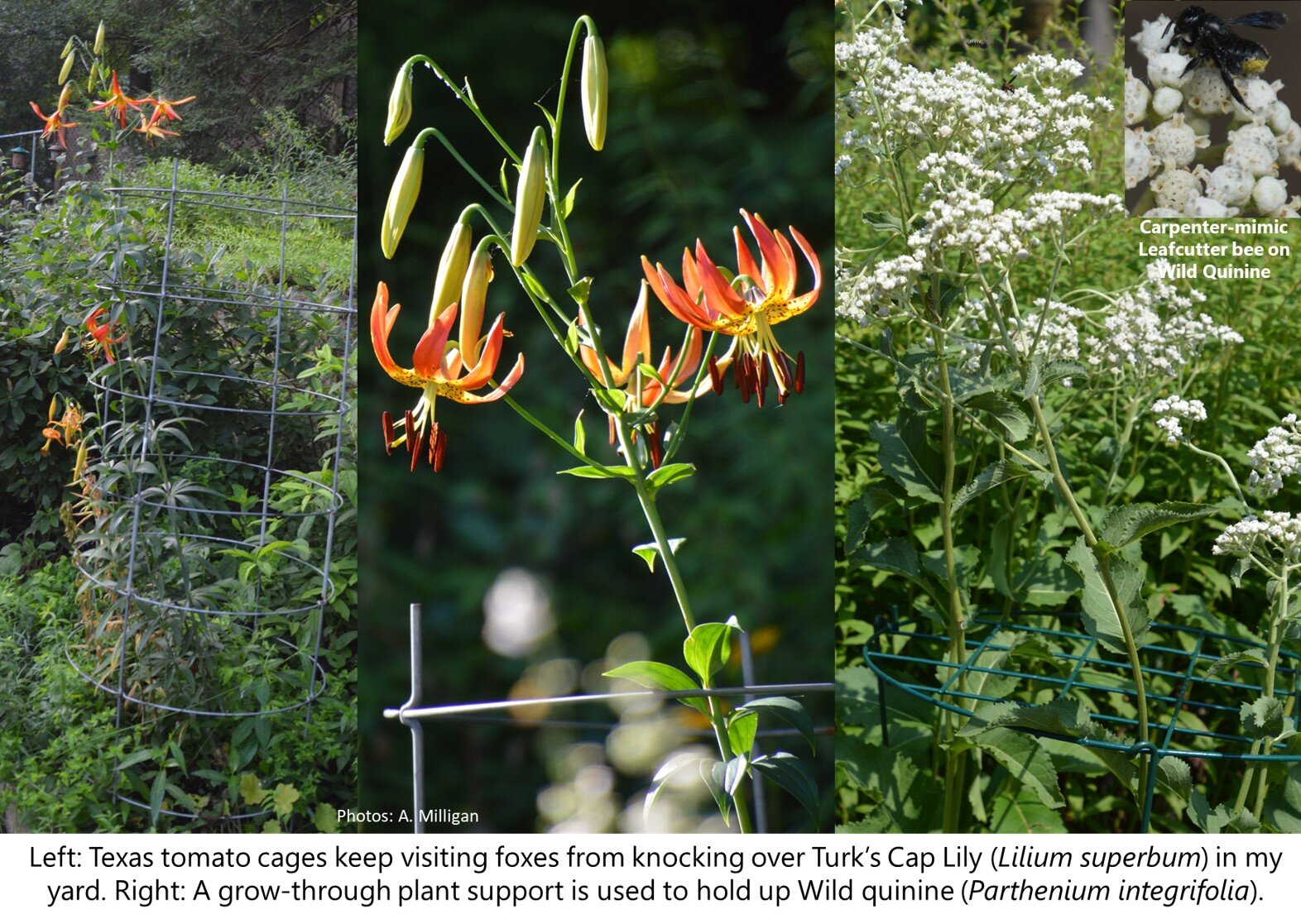
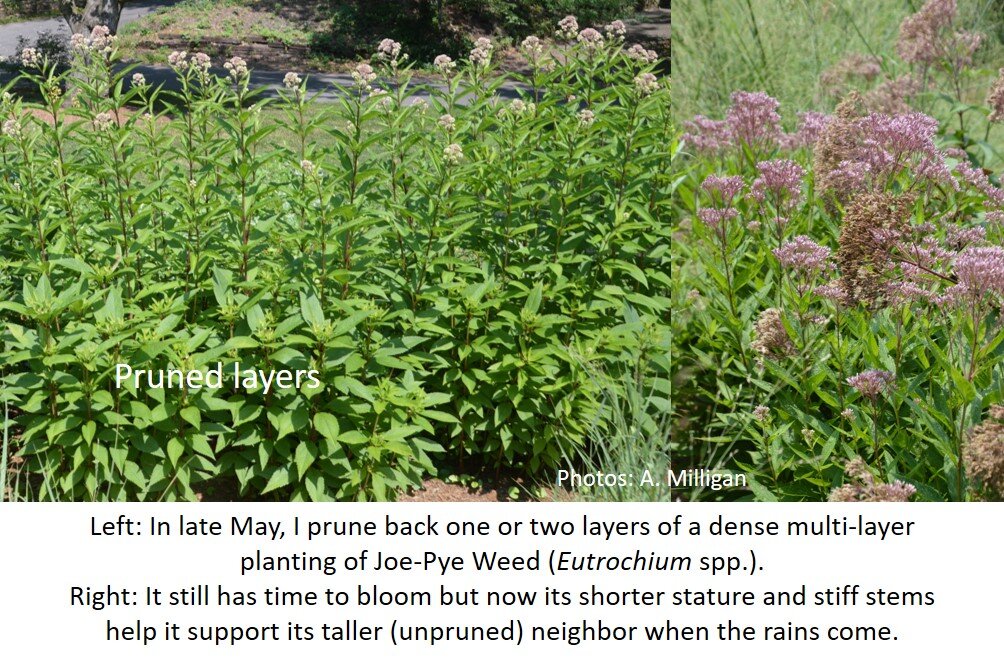
When people visit my home, I often hear them say, “You have so many tall plants! How do you keep them from falling over?”  As a native plant enthusiast, I don’t limit myself to just short plants – instead, I strive for biodiversity and finding the right plant to fit a site;  frequently that means planting one of the excellent, very tall perennials that Maryland is known for.  Over the years I have had to get creative to find ways to keep my plants standing tall while withstanding increasingly extreme weather. September is the wettest month of the year in Maryland and as we move further into hurricane season, I need to anticipate storms that can wreak havoc on a garden. 

Like many of you, I do most of the cleanup of my garden in early spring – rather than cutting plants back after blooming, I keep the seed heads of most plants available for birds and to provide overwintering areas for insects and the like.  Below are a few of the techniques I use to hold up plants in my garden:

Pollinator_Garden.jpg
Combo.jpg
TurksCap_Quinine.jpg
JPW_HoldingUp.jpg

Providing support for tall plants in your yard is important but in this time of coronavirus the more important question is, “How are you holding up?”  I miss spending time with my gardening and Watershed Steward friends. I can only hope you are all staying safe and that we will soon be able to get together again. Hopefully, like my Joe-Pye Weed, you are staying strong and providing your own support to a friend or neighbor. In the meantime, I will imagine you all doing a bit of native plant gardening.

~ Alison Milligan – Mstr. Gardener/Mstr. Naturalist/Mstr. Watershed Steward

Chesapeake Bay Landscape Professional (CBLP)

aligmilligan@gmail.com

Latin for Gardeners: July and August 2020

July and August Native Maryland Plants

Hypericum densiflorum Pursh.
(hy-PER-ee-kum den-see-FLOR-um)
Common Name: Dense St. John’s Wort

Hypericum prolificum L.
(hy-PER-ee-kum pro-LIF-ih-kum)
Common Name: Shrubby St. John’s Wort

Hypericum_Main.jpg

This month I want to share with you two plants that are commonly confused with one another: Hypericum densiflorum and Hypericum prolificum.  By discussing them side-by side I hope to show you how to differentiate them if you ever see them in your work or travels. These Hypericum spp. bloom all summer long, are native to the Mid-Atlantic states and are very low maintenance. Four years ago I planted a single specimen of each so I could learn to differentiate them; I sited them near each other along my driveway where they get full unobstructed sun and no maintenance.  They have been blooming profusely since early June and because of their proximity to one another are easily distinguished. 

Hypericum_Shrub_SideBySide.jpg

At first glance you notice that both the flowers and the leaves of H. densiflorum are noticeably smaller than those of H. prolificum and there are more flowers to each inflorescence.  True to its name, the habit and flowering of H. densiflorum is a much denser shrub with flowers that are tightly clustered. H. prolificum has a more open habit with slightly larger flowers that grow in less crowded clusters on a stem. The stems of each plant are worth a closer look:  H. densiflorum is smooth and copper colored while mature H. prolificum appears woody and exfoliates in winter, exposing a light brown to orange bark.

Hypericum_stems.jpg

Each plants’ flower has five petals and countless long yellow stamen that give the flower a frilly look -they can even obscure the petals. These flowers contain pollen but no nectar so bees are common visitors, butterflies are rare.  Interestingly, both shrubs are a host plant for the gray hairstreak butterfly (Strymon melinus) and several moths.  These Hypericum species leaf out early and are teeming with bees as soon as they get a single bloom.  They are often planted as erosion control plants; they have good drought tolerance and can easily be pruned to contain their height, if desired.

Hypericum_Genus_Species_bees.jpg

NOTE: Foliage contains a phototoxic chemical which deters deer and other herbivores.  Rutgers rates this plant a B: Seldom Severely Damaged by deer: https://njaes.rutgers.edu/deer-resistant-plants/

~ Alison Milligan – Mstr. Gardener/Mstr. Naturalist/Mstr. Watershed Steward

Chesapeake Bay Landscape Professional (CBLP)

aligmilligan@gmail.com