Latin for Gardeners: September 2021

September’s Native Maryland Plant
Silphium perfoliatum L. var connatum
(SIL-fee-um per-foh-lee-AY-tum var kon-NAH-tum)
Common Name: Cup Plant

Silphium_perfoliatum_main.jpg

During September, historically Maryland’s wettest month, I visit the ten rain barrels in my yard frequently - removing any debris from their screens and doing my best to drain them before the next storm.   Two years ago, I planted what I thought was the straight-species Silphium perfoliatum in front of the three 65-gallon cascading barrels above; the plants were a surprise gift from my friend, a notably experienced and excellent gardener.  They were already big plants with well-established roots, so I had high confidence they’d succeed being replanted. I knew they would flower best in full sun and that they could be aggressive spreaders so I sited them where they could ‘dress up’ my rain barrels and be somewhat contained.  So far it appears this is a case of ‘Right Plant, Right Place’ as well as a case of ‘Wrong Plant, Wrong Place’.

Silphium_perfoliatum_structure.jpg

Let me explain. The plant has flourished, its natural habitat includes road-side ditches and disturbed sites; it has also proven worthy of its common name - Cup plant. In May its meristems (young growth) are fully emerged, and the large serrated and sessile leaves have already formed a cup that captures rain and provides drinking water for bees and birds.  The hairy stems are one characteristic that set this species apart from the straight-species and how I identified this plant as var connatum. i.e. the ‘wrong plant’. I’ve read it’s native to the mid-Atlantic states, but lists disagree on whether that includes Maryland.

Silphium_perfoliatum_flower.jpg

Silphium spp. have a long bloom period and provide an abundance of flowers for pollinators. Their seed heads are enjoyed by birds in the fall. They are highly adapted to endure extreme weather and inhospitable site conditions – as they’ve shown in my garden where they’re in a highly exposed location, susceptible to wind and disturbance.

When accepting plants from friends or neighbors I’d like to offer a note of caution. In my experience, most people give plants from their garden because they have an excess of them – they do it in good faith and in friendship, never intending to do harm. However, frequently the ‘gifted’ plants are aggressive, non-native plants that can displace native plants – in the past I’ve been offered Daylilies (Hemerocallis spp.) and Lily-of-the-Valley (Convallaria spp.), two plants I know better than to plant due to their invasive nature. I’m always hesitant to accept plants as a gift, I have limited space in my yard, I give preference to certain plants, and I try my best to only plant natives.  I’ve been impressed with this Cup plant; it’s shown itself to be adaptable and very attractive to pollinators – combined with its water-storing ability I find it the perfect blooming companion to my rain barrels.

~ Alison Milligan – Mstr. Gardener/Mstr. Naturalist/Mstr. Watershed Steward

Chesapeake Bay Landscape Professional (CBLP)

aligmilligan@gmail.com

2021 Watershed Steward and Consortium Member of the Year

Each year the Anne Arundel County Watershed Stewards Academy honors volunteer Master Watershed Stewards and the environmental professionals who support their action for clean water. The Master Watershed Steward of the Year is awarded to a Steward(s) who excels in engaging their community to reduce pollution. The Consortium Member of the Year is awarded to an environmental professional who makes a significant impact on projects for clean water. The 2021 Master Watershed Steward and Consortium Member of the Year Awards will be presented at WSA’s Outdoor Exploration Field Conference on September 18th.

2021 Master Watershed Steward of the Year

Jessie Bradley adding to a pile of pulled invasive material at Sandy Point State Park. From January to July 2021, Jessie cleared more than 35,000 sq ft of invasives from the state park.

Class 9 Watershed Steward Jessie Bradley was honored for her dedication to eradicating invasive species at Sandy Point State Park and planting native trees. For the last two and a half years, Jessie has spent 2-3 hours nearly every day wrangling and removing stilt grass, multiflora rose, English ivy, and more, rescuing native trees and shrubs. Each month, she clears out the equivalent of two tennis courts worth of invasive vines/growth at Sandy Point! In 2020, Jessie trained as a Tree Trooper and planted 90 native trees at the state park, which she cares for alongside Ann Fleer, fellow Tree Trooper, and Class 9 Steward.

In addition to her restoration efforts, Jessie was integral in revamping how Stewards report their action, providing essential feedback while testing the state-wide WSA reporting system through UMD.

As part of his capstone project in November 2019, Phil and volunteers planted over 250 natives to refresh and restore an existing rain garden. Today, his committed team of congregants and Stewards maintains the projects year-round.

Phil Colbert, Class 11 Watershed Steward, received the Steward of the Year Award for his dedication to caring for an existing project at Mt. Moriah AME Church in Annapolis. In summer 2018, Mt. Moriah’s original Steward, Betty Powell, requested help caring for her capstone project, installed in 2016 as part of the RiverWise Program. With no prior experience with restoration work or caring for native plants, Phil’s desire to do something good for the environment and strong calling to be of service to his congregation propelled him to take the Certification Course and manage the projects at Mt. Moriah. Phil added new natives to the original project and replaced plants in patches where most of the original native growth had died off as part of his capstone project. 

Phil continues to mobilize his congregation to care for their projects. With support from Betty Powell and Congregational Steward Dr. James (Jim) Johnson, Phil partners with the Maintenance Corps for project clean-ups and continues to grow in his maintenance of the projects with a core group of volunteers. Under his care, the gardens are flourishing—a great example of a Steward caring for creation.

2021 Consortium Member of the year

2020_11_28_Jo_professional_shots_07.jpg

Johanna Doty was awarded Consortium Member of the Year for her work connecting Stewards and WSA with the Anne Arundel County Public Library. As a result of Johanna’s connections, we are reaching a greater number of residents across Anne Arundel County than ever before, developing ways to engage new audiences through bilingual and family programming, and supporting branches struggling to manage stormwater runoff. Because of her efforts, three librarians have trained as Watershed Stewards, representing the Crofton, Severn, and Maryland City branches. In 2020 and 2021, Stewards led programs and projects, including environmental literacy sessions, stream clean-ups, and tree maintenance at seven library branches. Additionally, Johanna increased WSA’s opportunities to create programming that reaches a broad audience and shines a light on environmental justice and social equity issues. In November, WSA and AACPL will partner to host an Environmental Justice panel, accommodating 1,000 participants across the state of Maryland.

2021 Ron Bowen Environmental Legacy Award

The Ron Bowen Environmental Legacy Award honors the impact of WSA co-founder, Ron Bowen by recognizing an individual who has made a unique contribution to environmental stewardship in Anne Arundel County by connecting government or institutional resources with private sector investments to generate significant environmental actions.

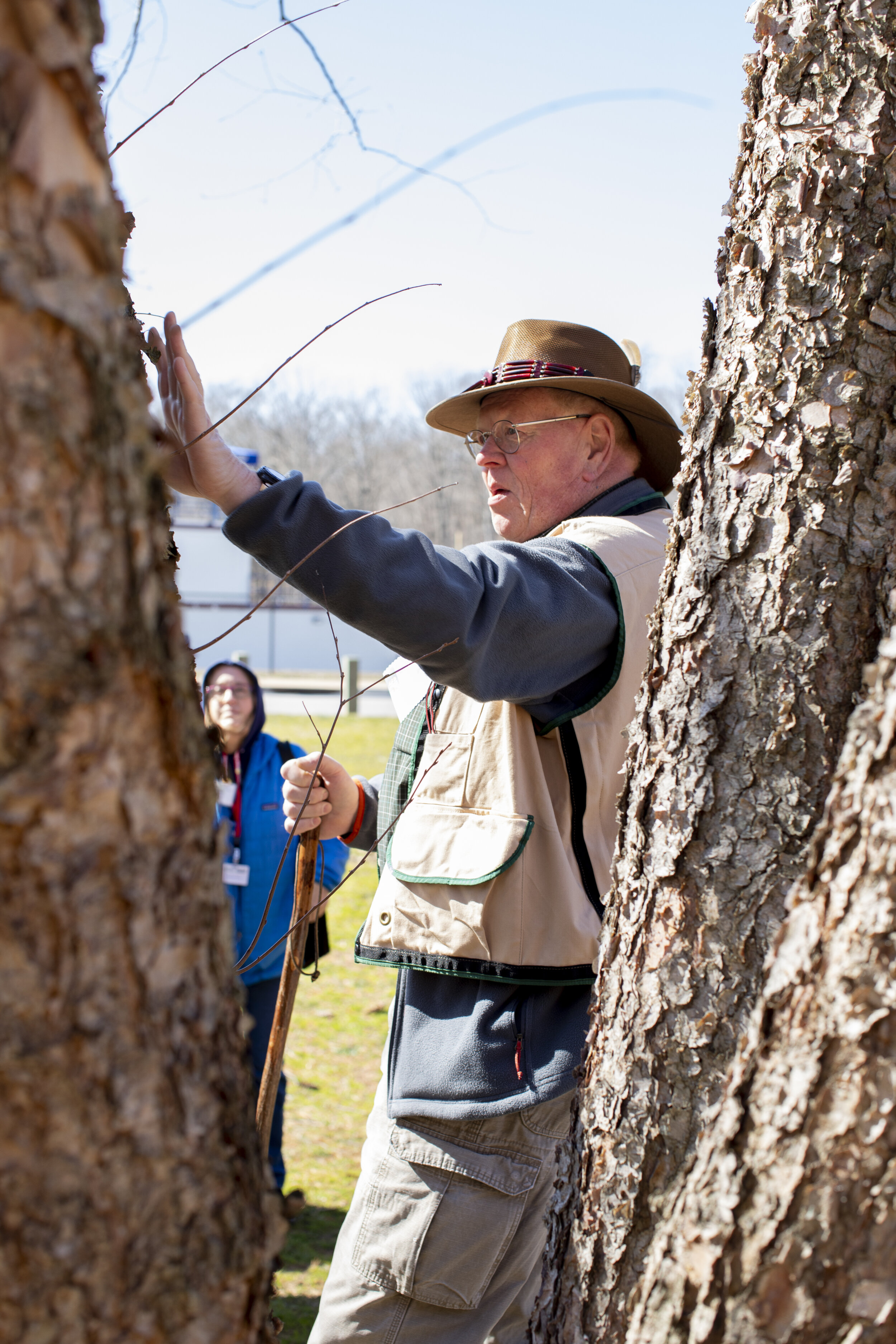
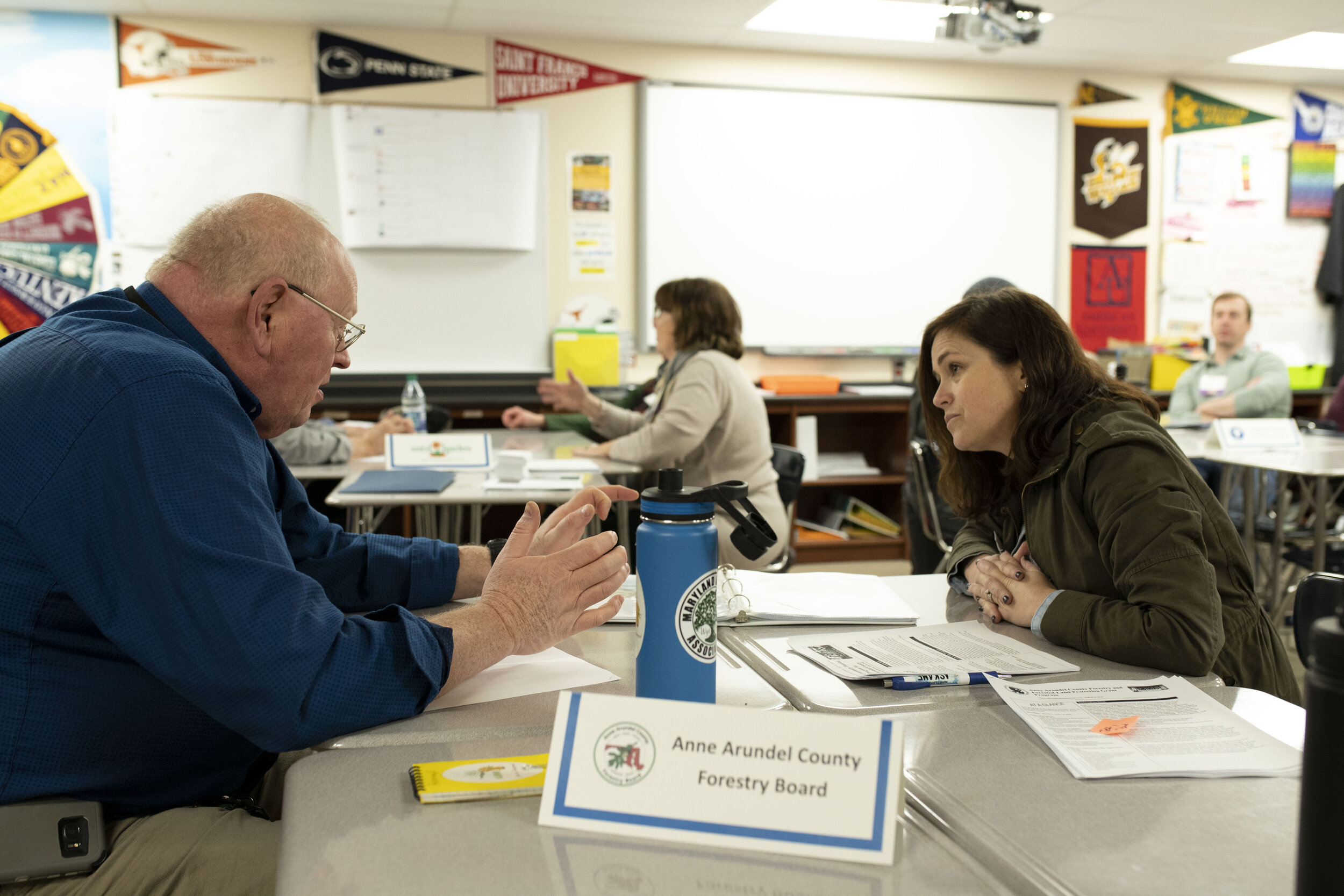
This year, we recognize Bud Reaves with the Ron Bowen Environmental Legacy Award. As an Anne Arundel County Forester, Bud’s passion for planting and protecting trees has made him a valuable resource to WSA over the years. With his knowledge of invasive plants and critical areas, Bud plays an instrumental role in many Steward projects, including identifying invasive species and suggesting native plants and trees to replace them. Additionally, Bud is a go-to resource for Stewards and Staff alike when it comes to identifying trees.

Bud founded the Anne Arundel Weed Resistance, a volunteer organization that removes invasive plants throughout Anne Arundel County. Through a series of trainings, volunteers learn to identify and remove invasive species like English Ivy and multiflora rose. Across the county, “Weed Warriors” implement their knowledge to eradicate destructive species on private and public lands. 

Bud has been an essential part of almost all of my Steward projects. Since 2010, with our first reforestation project together, Bud has offered countless hours planting, teaching, advising, identifying, coordinating, and just showing up with a machete, in support of my work as a Steward. Bud’s branches of knowledge are wide and he is so eager to share his information and time with Stewards, students and the public to advance forestry and conservation projects. He has patiently taught me everything I know about invasive plants and management techniques through the development of the Weed Warriors program. Bud encouraged me to pursue a forestry stewardship plan for my neighborhood, helped me to develop multiple site reforestation and planting plans, and has been a team lead in my weed warrior actions in my neighborhood, and adjoining natural areas. I know he has helped countless other stewards move from ideas to environmental action. Rooted in information, and with a genuine passion for his work as a forester, Bud is a giant in the canopy of environmental action.
— Lara Mulvaney, Class 1 Watershed Steward

Latin for Gardeners: July 2021

July’s Native Maryland Plant
Delphinium exaltatum
(del-FIN-ee-um eks-all-TAY-tum)
Common Name: Tall Larkspur

Delphinium_exaltatum_Main.jpg

July is our hottest month, a time when I prefer to ‘look but not touch’ my garden – it’s just too darn hot! Yet I want my garden to look great, full of color and blooming profusely so I can attract hordes of pollinators and observe them up close or at a distance. Delphinium exaltatum is one plant that exceeds my summer-blooming expectations both in flower-bearing and pollinator attraction. 

Thinking back a few years, I remember that I almost did not buy this species, mainly due to its very tall stature. I recall seeing this plant in my youth, along woodland borders and on roadsides in New England.  Today the biggest threat to roadside Delphinium is habitat loss, mainly due to physical disturbance, widening roads and the severe clearing regimen that severely impacts this and many other plants’ ability to flower or set seed.

Delphinium_exaltatum_nectar_source.jpg

Choosing to plant Delphinium in my landscape helps to sustain its population and guarantees that I have a tall blooming flower in the back of my beds that draws in butterflies and hummingbirds as well as a variety of bee species. Because it prefers cooler nights, I planted it where it receives only morning sun and where it is protected from strong winds.  The flower color ranges from white to lavender to purple and as its name implies, it is much taller than the earlier blooming and also native, Dwarf Larkspur (Delphinium tricorne).  

Delphinium_exaltatum_Misc.jpg

I find the structure and silhouette of this plant particularly captivating, and as to its stature, I’ve determined that many of my favorite perennials are very tall, excellent pollinator plants and often endangered; it’s up to me to plant them, to promote them and to support them however and whenever necessary – they reward me and pollinators many times over.


¹ A tapering, sometimes curving projection.

~ Alison Milligan – Mstr. Gardener/Mstr. Naturalist/Mstr. Watershed Steward

Chesapeake Bay Landscape Professional (CBLP)
aligmilligan@gmail.com