
Latin for Gardeners: September 2022
August’s Native Maryland Plant
Monarda punctata L.
(mo-NAR-da punk-TAH-tah)
Common Name: Spotted Beebalm

Monarda punctata is the second mint to be highlighted this ‘Year of the Mints’¹. Maryland’s native mints are tremendous pollinator plants that, in general, share the distinction of having a fragrance that deters deer. This mint, Monarda punctata, has a far-reaching native range, a long bloom period, and a showy appearance that makes it especially valuable in a pollinator garden. Meeting its growing conditions is the key to having it thrive and reseed – dry, sandy soil in full sun is where this plant will shine.
When in bloom Monarda punctata is worth a closer look. Its spotted flower petals are enhanced by the very conspicuous pinkish bracts that give the appearance of a flower in bloom - long past its flowering period.

Monarda species support many specialized bees (bees that require specific pollen), they are the larval host for several moths, and they attract beneficial wasps – animals that control insect pest populations. This means the plant helps increase plant, pollinator, and bird diversity while also providing integrated pest management (IPM) – a real win-win in any garden.

In case you missed it: On July 21st, 2022, the migratory Monarch (Danaus plexippus plexippus) was added to the endangered species list: https://www.iucn.org/. Just two days later a female Monarch came to my garden to lay her eggs. Just barely hanging on to a Swamp milkweed (Asclepias incarnata) she seemed to be sending me a message, ‘Do more’.
I really do hope you plant a native mint in your garden – there are many good options. I also hope you find room for a native milkweed (Asclepias); preferably one of these three: incarnata, syriaca or tuberosa. Keep in mind, that to complete their migration Monarchs will also need fall blooming plants.
Visit WSA’s RePollinate site to apply for some native milkweed for your garden – they’re free!2 If we all ‘do more’, then this iconic butterfly and many others will do more than just barely hang on.

1 MD Native Plant Society: https://mdflora.org/resources/Publications/Marilandica/Marilandica_Fall_2021.pdf
2 WSA accepts donations, or you can volunteer to help the RePollinate program
Alison Milligan – MG/MN 2013
Watershed Steward Class 7, CBLP, AA County Tree Trooper
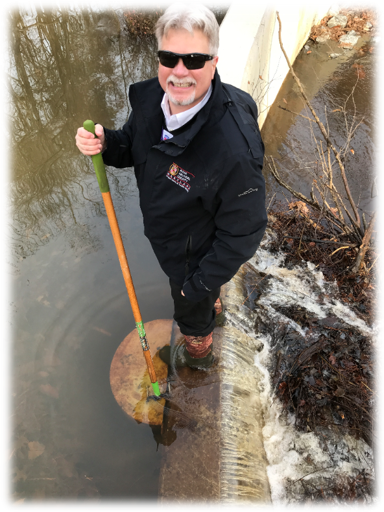
WSA is heartbroken at the loss of a dear friend, teacher, and mentor Ken Pensyl. In over 40 years of service to the environmental field, Ken made incredible contributions to statewide stormwater regulations at the Maryland Department of the Environment and at the local level here in Anne Arundel County. As the Program Manager for MDE’s Sediment, Stormwater and Dam Safety Divisions, Ken helped usher in a paradigm shift from collecting and conveying stormwater to holding and treating it in the landscape. The last 25 years have been a time of incredible innovation in our field and Ken was there to tackle the many implications of addressing stormwater in a completely new way, untangle complexities and help others navigate this new science.
Ken brought that expertise to Anne Arundel County, managing the maintenance of public stormwater facilities in the County. Ken shared his expertise with WSA as a key instructor for our Stormwater Success Course and our Watershed Steward Certification Course. His enthusiastic explanations of stormwater ponds and engaging site tours were an important part of learning for hundreds of community leaders across the County.

What set Ken apart, though, was not WHAT he did, but HOW he did it. Ken was easily the most knowledgeable and experienced person in any room when it came to stormwater, but you would never know it. His humble demeanor and easy-going personality made stormwater management approachable. With over 1,000 stormwater management devices to manage in the county, Ken was a busy person, but if you were interested in stormwater, he was interested in showing you all you wanted to see. He was never too busy to personally visit communities and follow up with helpful and detailed assessments of their water issues. No one’s problem was too small for his attention, and he was always excited to talk about stormwater. His passion for stormwater was truly infectious.
For me, Ken was a special mentor, who will be missed not only for his breadth and depth of expertise, but for his warm smile and the way he genuinely valued each person.
Our hearts go out to his family during this difficult time. For those who want to read more about Ken or his final arrangements, his obituary may be found here.
Suzanne

Hello everyone,
My name is Elizabeth Guzman, and I am a STEM student who recently graduated from North County High School (NCHS). I am currently a Steward candidate in Class 14, and I have learned a lot by being a Steward with WSA. These lessons include creating better communication skills (collaborating with different stakeholders/partners) and learning how to manage large-scale projects. I joined WSA as a high schooler because I want to pursue a career in the environmental field and what better way to do it than by getting involved in my community! I found that the certification course was easy to manage because of how well it was organized. I was able to plan so I can fit in my classwork and still be an active Steward by knowing important dates ahead of time. My favorite aspect of the course was how we were able to participate in site assessments that were introduced in class. We weren’t just able to learn skills but apply them to real-world situations when we went out in the field during class field trips.

Elizabeth delivering her native plants program to North County High School’s Environmental club.
For my capstone project, I worked with Alyssa Lee, another NCHS student who is also in Class 14, to create a two-part presentation on rain barrels and native plants that we were able to present to our classmates. Our capstone project went very well. We prepared a Kahoot (a trivia game platform) for each of the presentations and students were able to compete for sustainable prizes! Because of our teachers and WSA’s support in our endeavors, we were able to gather over 30 students to learn about these practices to mitigate stormwater! I can take away many lessons from being a steward, as many of them will be used in college, especially aspects of communication. I truly appreciate the time I have spent with WSA as it has only fueled my growth in the environmental field. I look forward to continuing studying the environment and sustainability at Cornell University in the fall!

Elizabeth, Alyssa, and fellow Class 14 stewards at their class project site.
Elizabeth Guzman
Class 14 Steward Candidate