Latin for Gardeners: March 2020

March’s Native Maryland Plant 
Chrysogonum virginianum L.
(kris-OG-oh-num ver-jin-ee-AY-num)
Common Name: Green and Gold
Chrysogonum_Main.jpg

As I look out at my garden in March it’s not surprising that I see plenty of bare soil, the ground is just beginning to warm and most plants are still dormant.  The evergreen ferns are covering some shady places, and the Virginia bluebells (Mertensia virginica) will be showing their heads any minute, but in many areas I’m aware that no plants will be emerging - I still need to plant, and a lot!  There are places in my yard, and probably yours, where runoff and erosion occur, and those areas are prime locations for native, densely planted groundcovers.

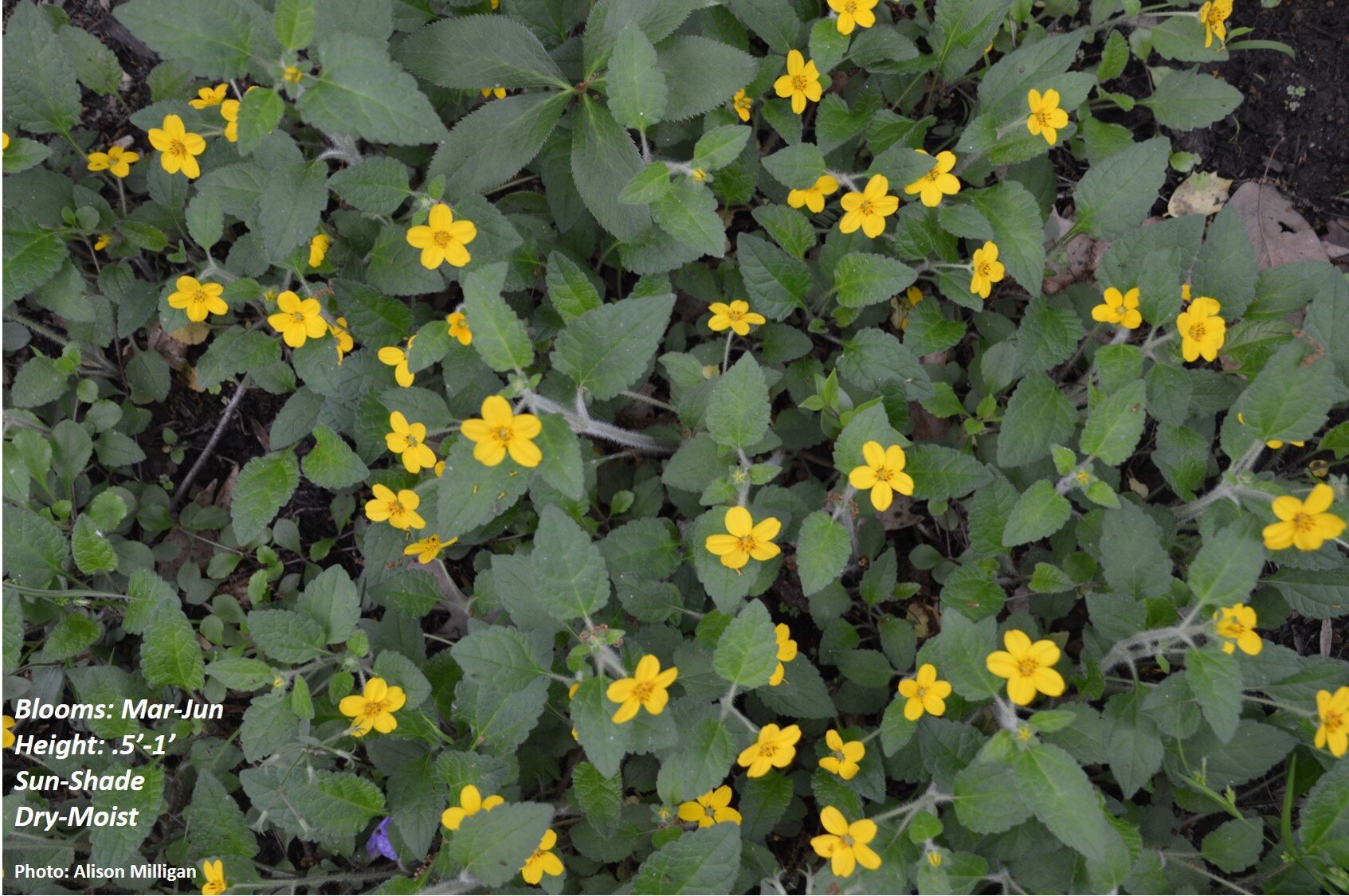
Low-growing and generally easy spreaders, groundcovers are useful on slopes, under trees, and in areas where weed suppression is needed; many of them will flower and some are evergreen. Chrysogonum virginianum is one such plant – it’s a rhizomatic, flowering, easy to find groundcover that keeps its foliage in mild winters.
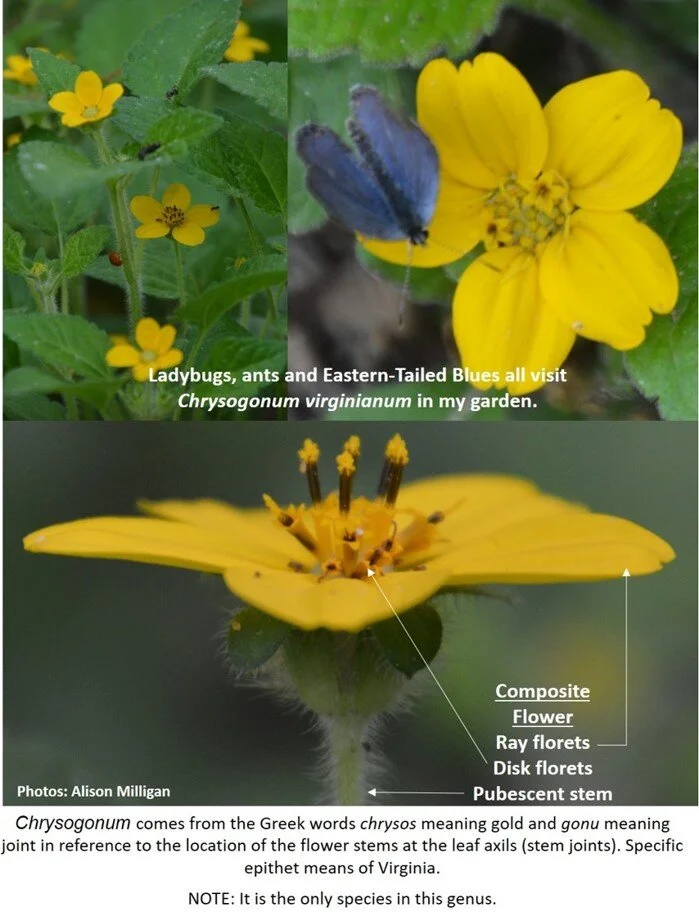
Chrysogonum_Misc.jpg

I have Chrysogonum spp. planted densely under trees and amongst various shrubs, including the now berryless Winterberry (Ilex verticillata). Its star-shaped, 5-petaled yellow flower lights up these areas in spring and summer and the nectar and pollen it produces attracts a variety of pollinators. I find that it takes light foot traffic and blooms longer in moister areas, so I’ll be adding it to a part-shade walking path along my dry riverbed.

As you look out at your garden and prepare for spring rains, you’ll be well rewarded if you plant this useful groundcover where there is bare soil with good drainage. You’ll also be protecting our rivers while increasing biodiversity in your landscape.

Stay tuned – next month we’ll discuss the host plant for the Spring Azure butterfly!

~ Alison Milligan – Mstr. Gardener/Mstr. Naturalist/Mstr. Watershed Steward

Chesapeake Bay Landscape Professional (CBLP)

aligmilligan@gmail.com

Acorn Hide and Seek

Written by Noelle Chao, Program Coordinator for WSA

1 Our acorns--where will we put them.JPG

On Wednesday, my family decided to do a nature walk at Greenbury Point in Annapolis.  We played Acorn Hide and Seek while we were there.  My eight-year-old son Nolan loved it!

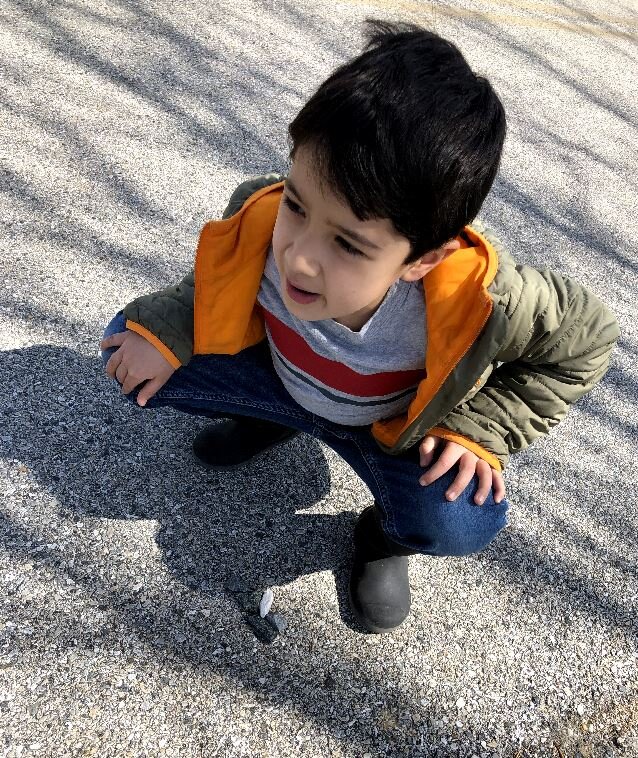
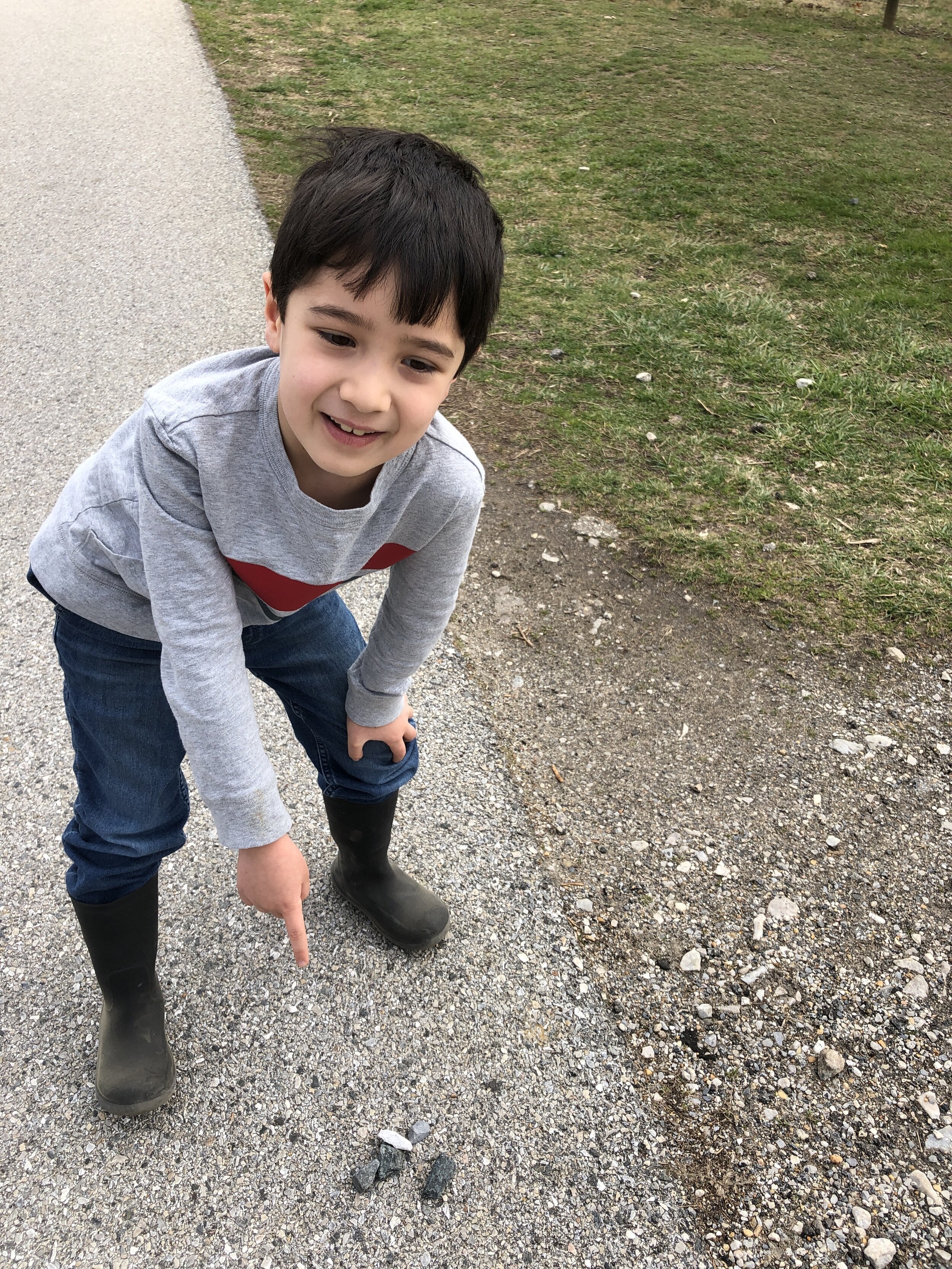
There wasn’t time to hunt for acorns before we set out, so we grabbed some rocks from the gravel path at our house and used those as our acorns.  Right away, Nolan was concerned that he would forget where he had hidden them.  So, he made the decision to hide his acorns in plain sight, right on the road next to the trailhead!  (This was a moment when my husband and I both had to take a step back and let him do the activity the way he wanted to do it.)

While we were on the hike, we talked about how we should be moving and behaving since we were squirrels, not humans.  What should we do differently?  Here's what Nolan said:

No technology!  Squirrels don't have iPhones!  (I had to get special permission to take mine out for photos.)

Work hard to blend into the environment.

Be on the lookout for predators and more food.

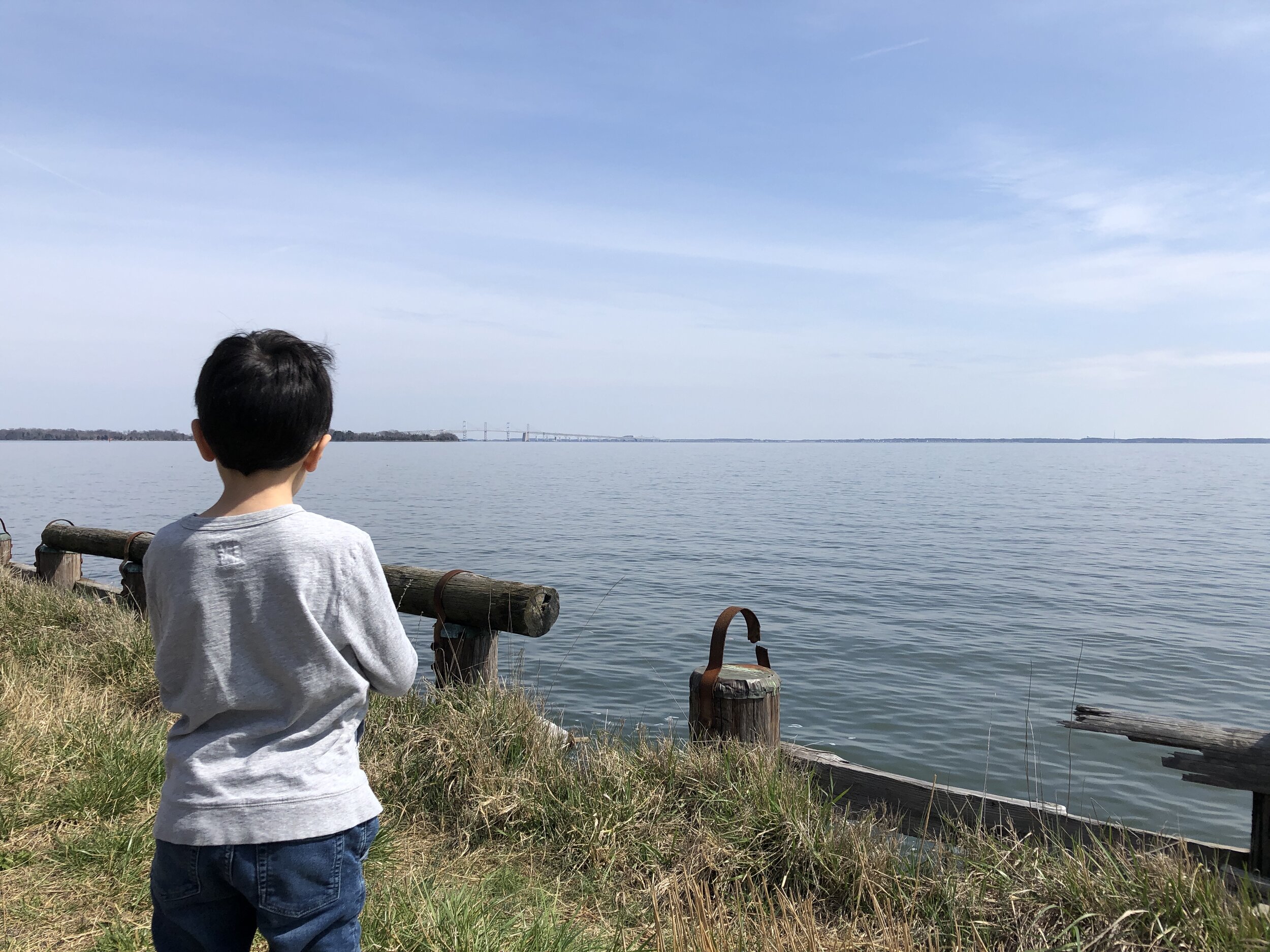
When we saw on osprey flying over the bay, we hid next to a tree.  Our squirrel family enjoyed beautiful views of the Bay.  We also wondered whether our acorns would still be there when we got back.  Nolan was a little concerned that someone else may have gotten to them... But when we got back, all of them were still there!  Success!

Later we asked Nolan . . .

How did it feel to be a squirrel?  “Just like how it feels to be a human!”

What skills do squirrels need to survive?  “Fastness, bravery, and skill. They should also have a good memory.”

What was your favorite part of the hike? “Seeing the osprey.”

Greenbury Point is a great local hike for families.  Just make sure you check their Twitter feed before you go, to make sure that the trail is opened.

And to keep kids happy and safe on a trail, remember to

Wear a hat and use sunscreen.

Bring water and a yummy snack.  No one has fun hiking when they’re hangry!

Be on the lookout for ticks.  To avoid them, stay in the center of the trail and avoid walking in tall brush.

Finally, a little background on my family and the great outdoors . . . my husband and I have been taking our son Nolan on hikes and nature walks since he was a baby.  Over the years, Nolan has transitioned from being carried, to riding in a metal-framed backpack carrier, to hiking 10-miles in the backcountry of a National Park.  This has taken a lot of persistence on our part, since if you ask Nolan, he would say that he hates being outside.  He’s very much a creature of the indoors and is happiest when he’s playing in his bedroom.  It’s always a struggle to get him out of the house for anything.  (Not surprisingly, he’s really taken to our family’s self-imposed quarantine!)  But what my husband and I have seen time and again is that the initial struggle to go outdoors—the arguing, the pouting, the complaining, the whining—immediately falls away once we get him on a trail.  Once we get moving, he always has a great time.

Take a mental break: Exploring nature during self isolation

It’s no secret that spending time outside can reap benefits for your mental health. Regardless if we’re in the office or working from home, the WSA team takes quick breaks regularly to “get up and get out.” We find when we take a stroll around the block, or practice a 10 minute mindfulness routine outside, we feel less stressed and more focused when we return to work.

Below are a few resources to get you up and out! Check our Facebook page for more resources in the coming days.

Have kids at home?  Start training your own Junior Master Watershed Steward!

Tips for experiencing nature and de-stressing in the outdoors.

  • For more information on how nature impacts your wellbeing, check out this article from the University of Minnesota or this podcast from NPR.

  • If you’re interested in practicing mindfulness outdoors, this is a great place to start! While the resource is formatted for students, you can easily adapt it to practice alone or with your family.

Rosie Trash.jpg

COVID 19: An update on our programs and projects

WSA Master Watershed Steward Certification Course  Class 12 Steward Candidates  have completed  2/3 of their coursework since last October, with 4 classes remaining this Spring.  While some of the content for these classes will be converted to online platforms (and thus also available for any Certified Stewards who would like a refresher!), the field based sessions including the Capstone Intensive and the Class Project will be reschedule when the “coast is clear”.  Capstone Project are being planned with the majority scheduled for fall installation.   

Backyard Buffers  Currently buffer bundling and distribution is scheduled for April 14-15, however there is a good chance this date will change.  Stay tuned for updates!

Replant Anne Arundel  Josh and Alyssa are hard at work developing outreach materials and fun tools  for Tree Troopers.  The initial Tree Trooper training will be rescheduled when the “coast is clear”.  A second training is planned for June 6th.  Most trees will be planted from September-November 2020.

Stormwater Success  This WSA short course for property manager and HOA leaders  is scheduled for May 4, 9, and 16th, but like everything else this spring, we are adopting a “wait and see” approach.  More information may be found at: http://aawsa.org/stormwater-success-event

If you have questions about any other WSA programs, please contact Noelle Chao, nchao@aacps.org