My Social Distancing Storytelling Stick

By Nan Henry

This is the story of my storytelling stick.  Each item tied to the stick reminds me of my afternoon walk.  The items I have selected may not make sense to you yet. But as I recount the details of my walk, you’ll understand why each item on my storytelling stick represents something special I saw this afternoon.

storytelling stick.png

The blue and white beads tied to the top of the stick remind me that the sky was blue with just the occasional cloud.

Next, I’ve tied on a rock.  My street is having its water pipes replaced and the road has been torn up.  There are many temporary patches. This rock was from one of those patches.

It was very windy.  The feather reminds me of how things were flying around in the wind.

A Redbud twig with its beautiful bright pink buds can only mean that it’s spring!

A lot of people were out walking their dogs.  In my neighborhood, pet owners are very good about picking up pet waste.  That is represented by the little bit of plastic bag.

On a sunny afternoon, many parents were out with their children getting fresh air or exercise, enjoying the afternoon while keeping their distance from other families.  The locust bean pod shakes like a rattle and reminds me of those children.  

The last memento is mulch from the now-empty playground by the school.  People are playing in the field or bicycling on the path, but not touching play equipment others might have touched.  

This stick is now like a pictorial journal.  If I had collected the items and not looked at them for weeks, I might have forgotten what they represent.  But I have shared my story with you soon after the walk and told you all about my storytelling stick. Because I revisited the memory and described all the different objects, in a week or two, I will still recall what each of these objects signifies.  I will still be able to tell you and others about my afternoon walk during a time of social distancing.

So that is my memory from today’s walk through my neighborhood.  I collected items and arranged them on a storytelling stick to prompt my recollection of my afternoon stroll.  Perhaps you could use those events and weave them into a tale of fiction. Once upon a time . . . . 

Latin for Gardeners: April 2020

April’s Native Maryland Plant 
Viburnum acerifolium L.
(vih-BUR-num a-ser-ih-FOH-lee-um)
Common Name: Maple-Leaved Arrowwood

Viburnum_acerifoliumMain.jpg

This month marks the beginning of my fourth year writing Latin for Gardeners.  Looking back at the list of plants I’ve discussed I was surprised that I had yet to mention any Viburnum species. This specific one, V. acerifolium, is one of my favorite shrubs, for multiple reasons.  It has great fall color, attracts a diversity of pollinators, is a host plant for the Spring Azure butterfly and its dense branches are where I often see birds foraging or nesting.  They also enjoy the black berries that appear in early fall! 

Viburnum_acerifoliumMisc.jpg

V. acerifolium prefers some level of shade, it will not endure boggy soil or over-watering but will tolerate drier conditions. It occurs naturally in beech-maple forests, thriving in rich deciduous woods, often amongst oak where it benefits from the acidic leaf litter. It’s also tolerant of black walnut toxicity.

Although I have many Viburnum spp. in my yard, I have yet to see the destructive Viburnum leaf beetle. I inspect my plants in spring before they leaf out and if necessary I’ll aggressively prune or treat them. Providing the best possible growing environment allows for a healthier plant which is always the best defense against any plant-eating insect or disease.

V. acerifolium is not found at most garden centers so if you find one and choose to buy it, (and I hope you do), I recommend you purchase the biggest plant you can find!

*Corymb: A flower cluster whose lower stalks are proportionally longer so that the flowers form a flat or slightly convex head.

NOTE: Spring azure photo used with Mary Anne Borge’s permission: https://the-natural-web.org/

~ Alison Milligan – Mstr. Gardener/Mstr. Naturalist/Mstr. Watershed Steward

Chesapeake Bay Landscape Professional (CBLP)

aligmilligan@gmail.com

An Update from our Executive Director

Rose+and+Suzane.jpg

Hello out there, WSA family and friends,

It’s gonna be ok.  I have been struggling for a way to say this to you all week. This message is reaching many people with countless and varied circumstances. There is real pain and hardship out there. There is also tremendous reason for hope. Times like these require great leaders, and great leadership will be needed when it is time to restore our communities. So, I feel optimistic today, and I know that it’s gonna be ok because we have leaders in our communities.    

The good we each do, seeps into the earth and replenishes our communal aquifers.
Gravely stream restoration. Learn about this Arundel Rivers Federation project here. Photo credit: Lara Mulvaney

Gravely stream restoration. Learn about this Arundel Rivers Federation project here. Photo credit: Lara Mulvaney

I was in a meeting earlier this week with the leaders of many of Anne Arundel County’s environmental groups. I was struck by two things.  First almost every organization was represented on that video call by a Master Watershed Steward --Amy Clements (Spa Creek Conservancy), Elvia Thompson (Annapolis Green) Betsy Love (Severn RiverKeeper), Anne Arms and Chuck Gallegos (St Luke’s Restoration of Nature), Bryan Gomes (Clearshark H2O), Nina Fisher (Scenic Rivers Land Trust). What a power house! Second, the phrases that have been popularized by great leaders in response to Covid-19, “We are all in this together” and “it takes all of us” have always been true of our environmental community and are true now more than ever, about the incredible task of restoring our local waterways. The good we each do, seeps into the earth and replenishes our communal aquifers. I am so grateful to know you are out there, and for the relationship I have with each of you and the relationships you have with each other, which, I hope, will help sustain us in this time of distance. 

Nina Brackman leading a yoga practice on Almshouse Creek. This photo is a memory from Summer 2019. These days Nina practices social distancing by staying centered in her own backyard.

Nina Brackman leading a yoga practice on Almshouse Creek. This photo is a memory from Summer 2019. These days Nina practices social distancing by staying centered in her own backyard.

I’ve enjoyed seeing how many of you are living out your stewardship even with limited mobility. Chris Gordon and his quarantine slogan “Gardening isn’t canceled”, Nina Brackman helping people stay centered with their yoga practice, Betsy Love sharing nature images from St Luke’s, Lara Mulvaney posting pictures of new trees in the Gravely stream restoration behind her house, Maggie Hughes teaming up with Elvia Thompson to bring Flowers and Trees into our living rooms through their Green Drinks Facebook watch party. So many examples of how Stewards are taking action remind us that our rivers and streams are still out there – still in need of our help.

I’ve heard from others who are taking a break from stewardship action, taking this time to focus on family, health and rest from community leadership. If this is you, rest, recharge, reflect, be present to this moment.  It is ok. It is more than ok – it is critical, because when this crisis lifts, we will need you. That time seems distant and unclear right now, but, as my mother always says to me, this too shall pass. And, when it does, we’ll be ready.  Because, it takes all of us to heal our waterways. 

Latin for Gardeners: March 2020

March’s Native Maryland Plant 
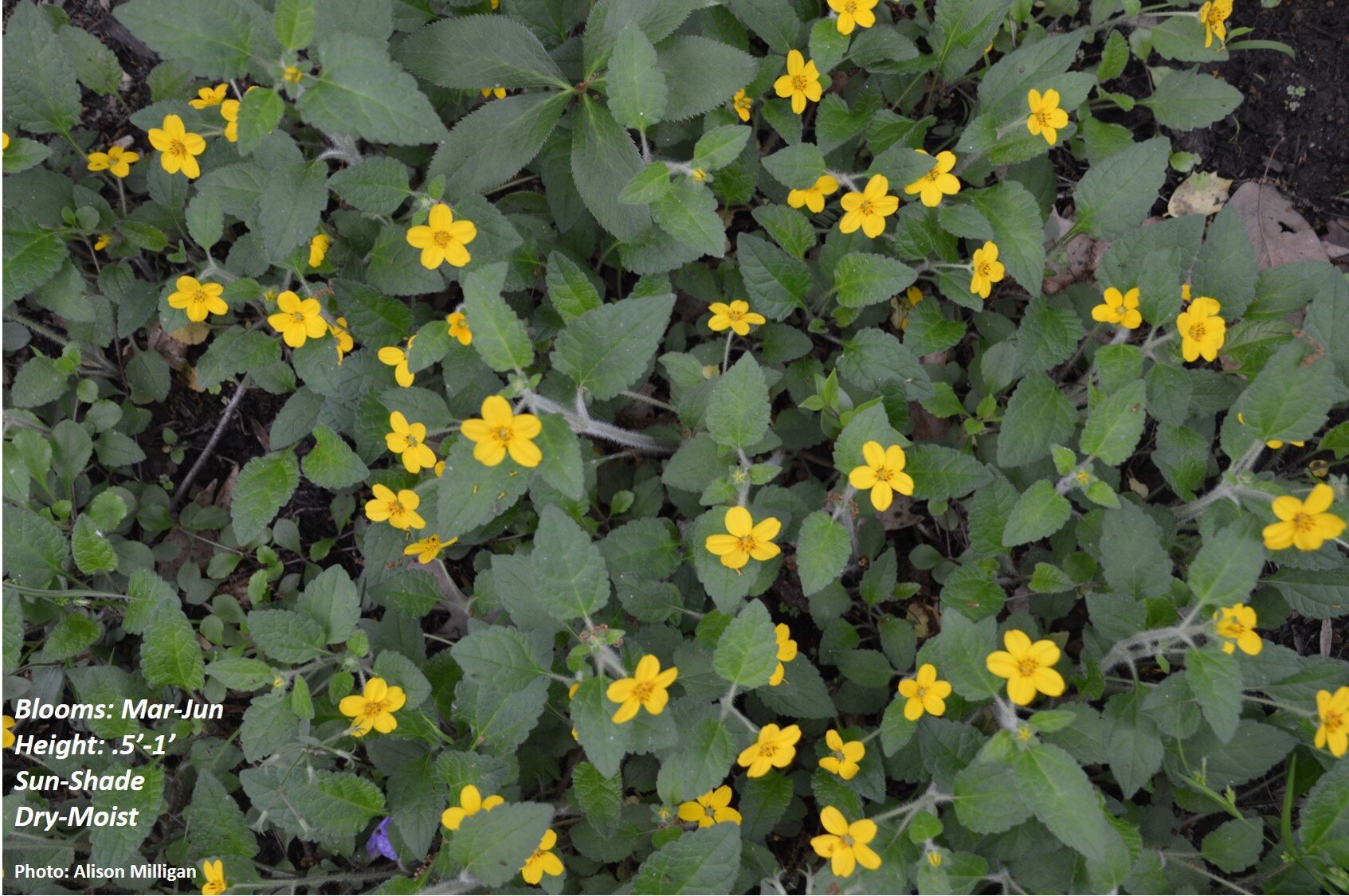
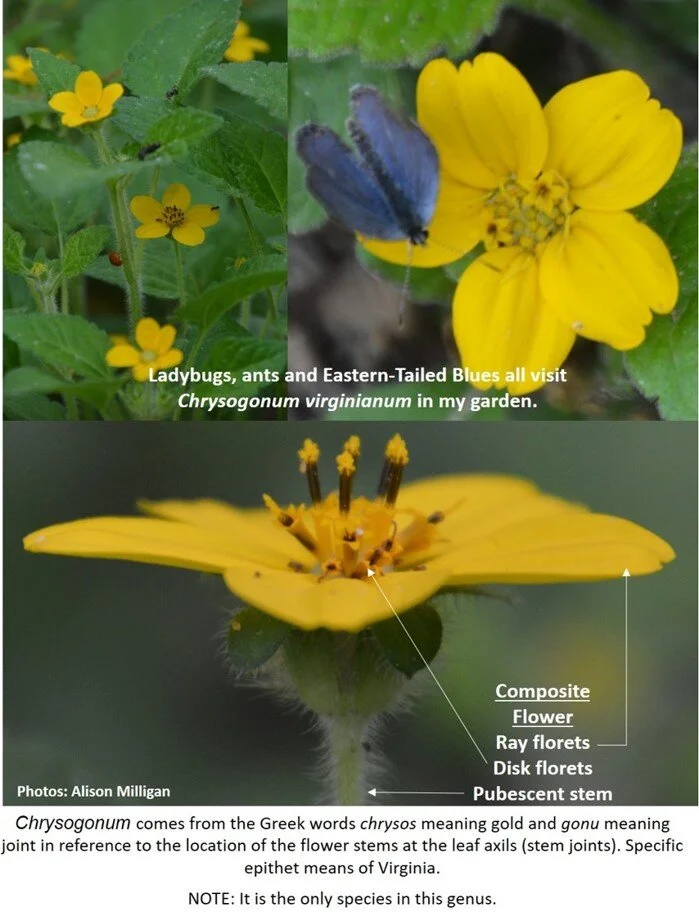
Chrysogonum virginianum L.
(kris-OG-oh-num ver-jin-ee-AY-num)
Common Name: Green and Gold

Chrysogonum_Main.jpg

As I look out at my garden in March it’s not surprising that I see plenty of bare soil, the ground is just beginning to warm and most plants are still dormant.  The evergreen ferns are covering some shady places, and the Virginia bluebells (Mertensia virginica) will be showing their heads any minute, but in many areas I’m aware that no plants will be emerging - I still need to plant, and a lot!  There are places in my yard, and probably yours, where runoff and erosion occur, and those areas are prime locations for native, densely planted groundcovers.

Low-growing and generally easy spreaders, groundcovers are useful on slopes, under trees, and in areas where weed suppression is needed; many of them will flower and some are evergreen. Chrysogonum virginianum is one such plant – it’s a rhizomatic, flowering, easy to find groundcover that keeps its foliage in mild winters.

Chrysogonum_Misc.jpg

I have Chrysogonum spp. planted densely under trees and amongst various shrubs, including the now berryless Winterberry (Ilex verticillata). Its star-shaped, 5-petaled yellow flower lights up these areas in spring and summer and the nectar and pollen it produces attracts a variety of pollinators. I find that it takes light foot traffic and blooms longer in moister areas, so I’ll be adding it to a part-shade walking path along my dry riverbed.

As you look out at your garden and prepare for spring rains, you’ll be well rewarded if you plant this useful groundcover where there is bare soil with good drainage. You’ll also be protecting our rivers while increasing biodiversity in your landscape.

Stay tuned – next month we’ll discuss the host plant for the Spring Azure butterfly!

~ Alison Milligan – Mstr. Gardener/Mstr. Naturalist/Mstr. Watershed Steward

Chesapeake Bay Landscape Professional (CBLP)

aligmilligan@gmail.com